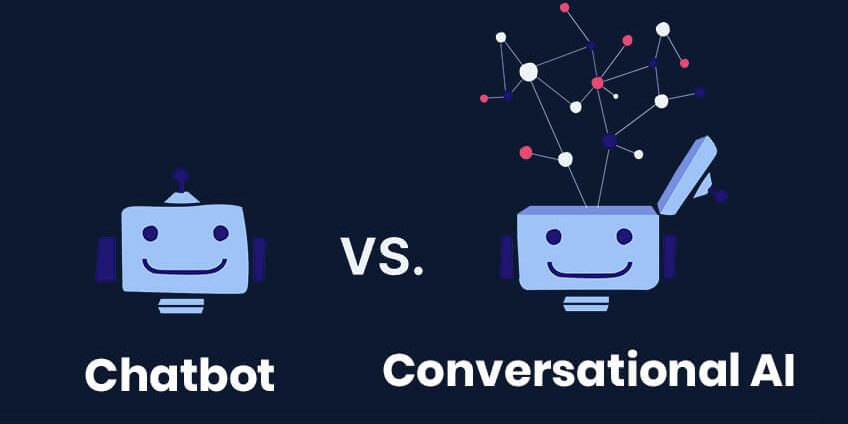
In the fast-evolving world of customer service, automation, and artificial intelligence, two key players have emerged: Traditional Chatbots to Conversational AI. While they may seem similar at first glance—both are designed to chat with users—their capabilities, intelligence, and impact on user experience are vastly different.
In this fast moving world where everything is on tip weather it is customer service, artificial intelligence and automation. Technology has emerged from Traditional Chatbots to Conversational AI and our life revolve around it. Both of these are designed to reduce our efforts and make our work easier with the capabilities and intelligence.
In 2025, learning the difference between traditional chatbots to Conversational AI is crucial for businesses, marketers, and developers aiming to stay competitive. In this guide, we’ll break it down in simple terms and help you decide which is right for your business.
What Is a Traditional Chatbot?
Comparison between Traditional Chatbots to Conversational AI has been going on from a very long time. Traditional chatbots are rule-based systems designed to simulate basic conversations. These bots operate using pre-defined scripts, keyword triggers, and flowcharts. When a user types a question, the bot looks for specific keywords and responds based on a set of programmed rules.
Key Features:
- Pre-set responses
- Limited understanding of context
- Works best with yes/no or multiple-choice queries
- Doesn’t “learn” over time
- Cheaper and easier to build
Example:
User: “I want to check my order status.”
Chatbot: “Please enter your order number.”
(If order number is invalid, the bot may get stuck or repeat itself.)
Traditional bots are great for simple tasks like:
- FAQs
- Booking appointments
- Order tracking
- Basic lead collection
What Is Conversational AI?
Conversational AI is a more advanced form of chatbot technology powered by natural language processing (NLP), machine learning (ML), and sometimes large language models (LLMs) like ChatGPT or Google Gemini.
These systems can understand context, intent, and even sentiment. They don’t just follow scripts—they learn from interactions and become more intelligent over time.
Key Features:
- Understands natural language (e.g., “Can you check if my package has shipped?”)
- Can handle open-ended questions
- Learns and improves from previous interactions
- Offers human-like conversations
- Can personalize experiences
Example:
User: “Has my order shipped yet?”
Conversational AI: “Let me check that for you. Can you share your order number?”
(It then verifies and continues naturally based on user input.)
These systems are used in:
- Customer service at scale
- AI voice assistants (Siri, Alexa, Google Assistant)
- Healthcare and banking support
- E-commerce chat
- AI search engines
Why Conversational AI Is Taking Over in 2025
In 2025, user expectations have evolved. People expect quick, personalized, and natural conversations—whether they’re booking a flight or troubleshooting a product.
Chatbots To Conversational AI – Here’s why Conversational AI is dominating:
- Mobile-first and voice-first behavior: More people use voice search or smart assistants.
- Context matters: AI can recall previous interactions, unlike rule-based bots.
- Reduced friction: Users don’t need to adapt to rigid scripts.
- AI is affordable now: Tools like ChatGPT, Claude, and Perplexity have made AI bots more accessible.
- Multilingual capabilities: AI bots can speak multiple languages, expanding global reach.
Which One Should Your Business Use?
Here’s a quick guide:
- Small local business: Traditional chatbot (for quick setup and low cost)
- E-commerce store: Conversational AI (for smart product recommendations and support)
- Healthcare or finance: Conversational AI (for secure, complex queries)
- Lead generation site: Start with chatbot → upgrade to AI
- Enterprise or SaaS: Conversational AI with full integration (CRM, analytics, etc.)
Chatbots To Conversational AI – Real-World Use Cases
Traditional Chatbot Example:
- Restaurant Booking: “Choose a time and date.”
- Lead Form: “Please enter your name and email.”
Conversational AI Example:
Travel Booking Assistant:
- “I want to fly to London next Friday and return Sunday. Can you book economy?”
- AI: “Sure! Here are flight options under €300. Would you prefer morning or evening?”
Customer Support:
- “My package hasn’t arrived, and I need it urgently.”
- AI: “Let me check your shipping status. I see a delay — I can escalate this for faster delivery or offer a refund. What would you prefer?”
Final Thoughts: Traditional Chatbots to Conversational AI?
The choice between Traditional Chatbots to Conversational AI depends on your goals, budget, and user needs.
If you just need a basic assistant to answer common questions, a chatbot might do. But if you want to deliver natural, intelligent, human-like support that scales, Conversational AI is the future — and the future is already here.
Also Read : A Beginner’s Guide to the Conversational AI Technology (2025)